National University of Singapore, Division of Industrial Design
Guided by Prof. Gabriel Lipkowitz
Spatial Computing Platform — Product Innovation
In collaboration with Ang Sze Ern, Alex Ong & Danikh Aqib
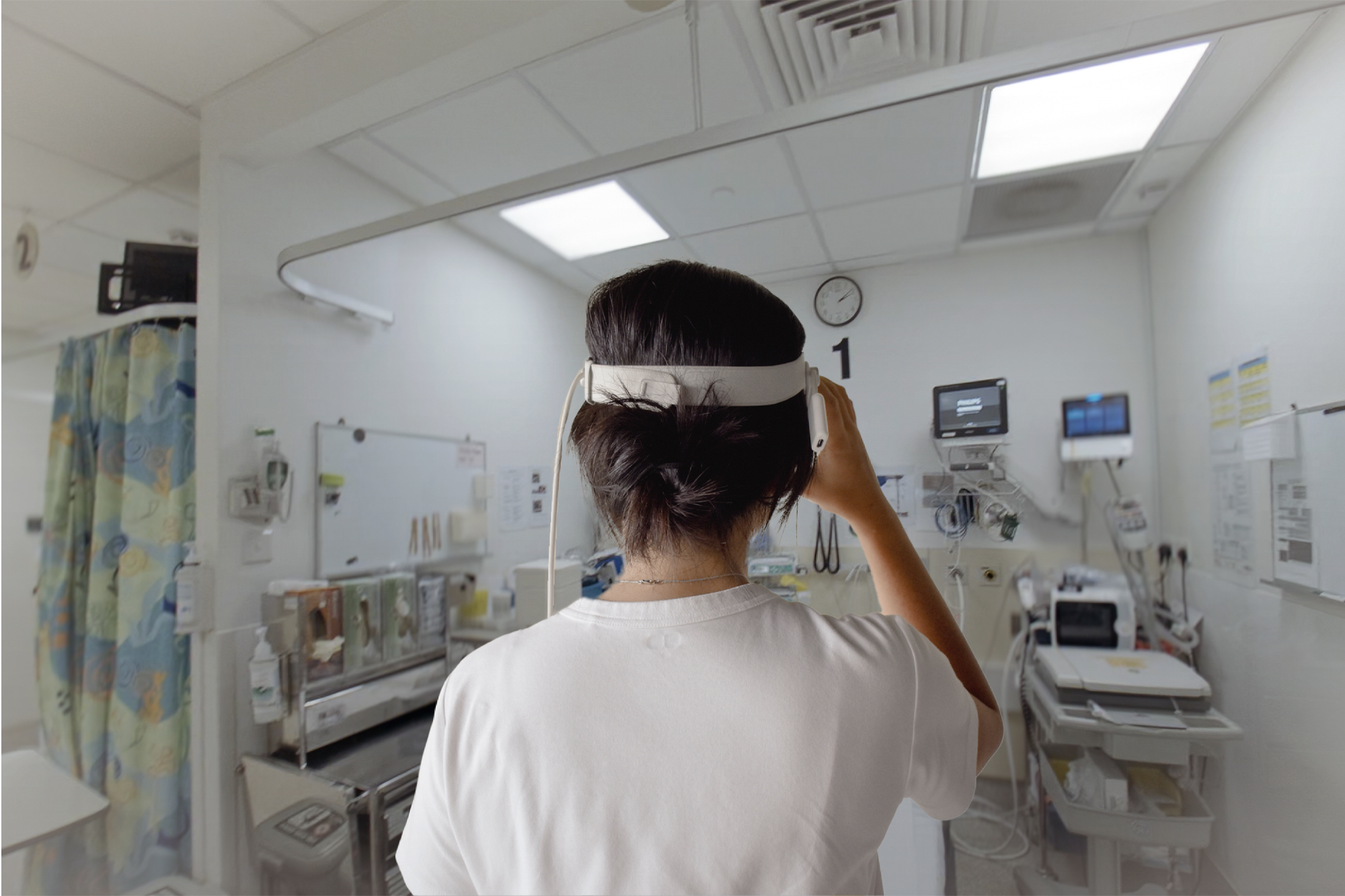
Simon is an immersive on-call simulator designed to familiarise junior doctors with the realities of hospital on-call work before they encounter it alone. Early on-call shifts are often marked by minimal onboarding, fragmented supervision, and high emotional stakes. Doctors are expected to prioritise, make procedural decisions, and respond to emergencies in real time, often without a clear framework or sufficient support.
By simulating authentic hospital environments and on-call scenarios, Simon offers a safe, repeatable space for doctors to practise decision-making under pressure. The system focuses on exposure rather than instruction, helping junior doctors build confidence, reduce cognitive overload and transition more smoothly into real-world on-call duties.
The Reality of On-Call Shifts
Junior doctors often enter on-call work with little structured onboarding, typically just one or two shadowing shifts, before being expected to manage complex situations independently. Learning is largely driven by trial and error, as time constraints limit formal guidance. During shifts, everything feels urgent: routine checks, time-sensitive tasks, and true emergencies compete for attention without a clear framework for prioritisation. Senior support is often limited, forcing junior doctors to assess urgency and decide when to escalate on their own, leading to hesitation and second-guessing. This uncertainty, combined with high workload and exposure to traumatic situations, contributes to pre-call anxiety, sustained stress, and burnout — causing some doctors to avoid on-call roles altogether.
How might we provide a realistic, approachable way for junior doctors to practice decision-making skills and learn from on-call scenarios before their first real shift?
Introducing Simon
1. Guided Onboarding Users are introduced to Simon through a step-by-step onboarding process with visual guidance, easing them into both the technology and the on-call workflow.
2. Contextualised Scenarios Each session begins with clear context-setting. Doctors can select from a range of comprehensive scenarios filmed in real hospital settings, replicating typical on-call cases they will face in practice.
3. Immersive Spatial Simulation Doctors are transported into digital twins of NUH wards. High-fidelity visuals and spatial audio recreate the urgency and atmosphere of real on-call shifts. As users navigate scenarios, Simon’s foundation model provides responsive feedback on decision-making and reasoning.
4. Reflection and Progress Tracking Each session concludes with a summary and archive, allowing doctors to review their decisions, reflect on alternatives, and track progress over time.
Learning Before It Counts
On-call work is deeply situational, shaped by environment, urgency, and constant interruption. By recreating these conditions, Simon allows junior doctors to practise decision-making through experience rather than instruction, within a safe and repeatable space. Moving beyond flat, 2D simulations and reliance on constant senior guidance, spatial immersion builds familiarity where uncertainty once dominated. This familiarity supports clearer judgment under pressure and a more confident transition into real on-call duties.
Credits Models: Ang Sze Ern Images by: Ryka Nouvin