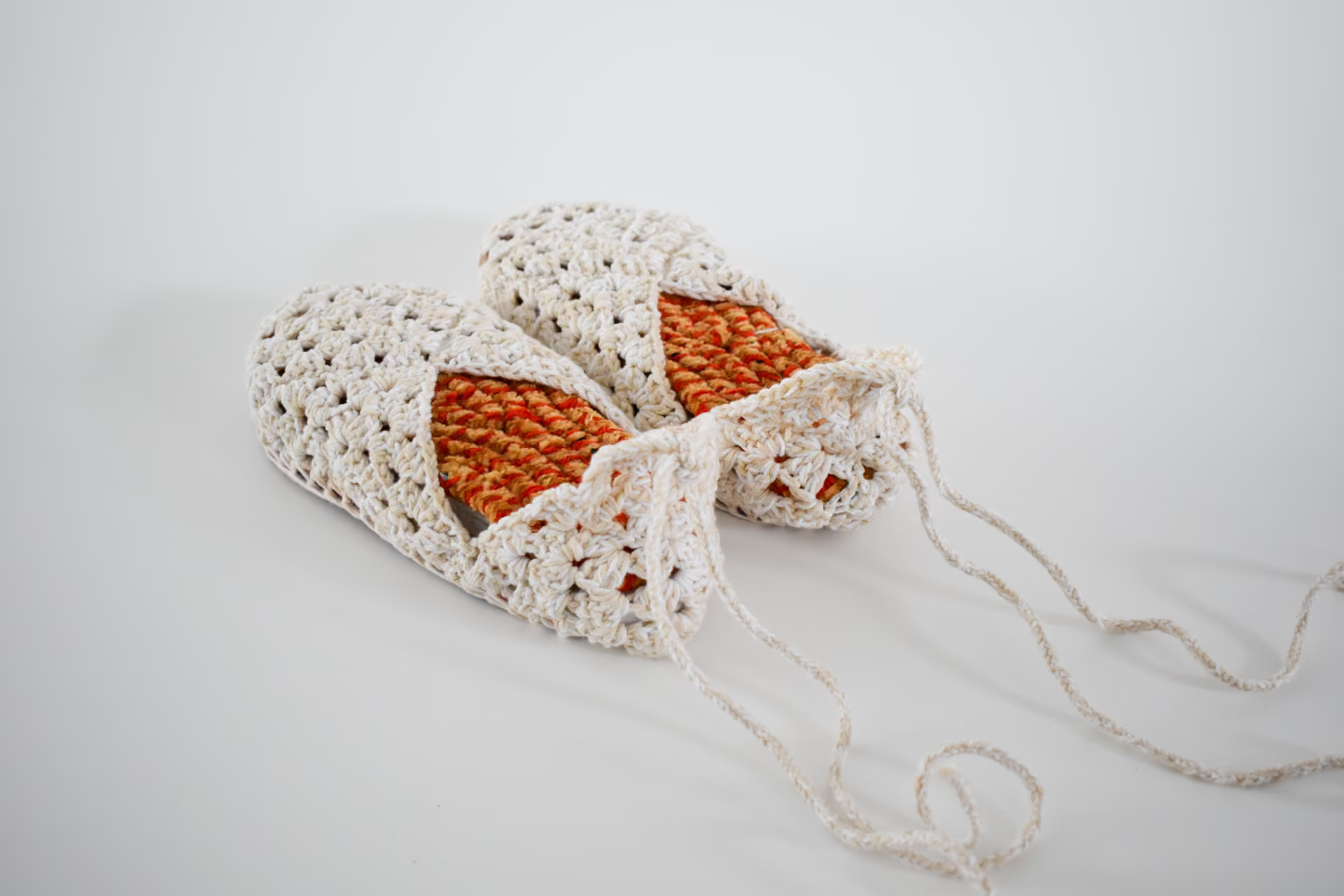
Joget Joget Kaki (JJK) is a wearable rhythm game that translates the experience of arcade dance platforms into something more personal and portable. Instead of stepping on a fixed dance pad, users interact through a pair of sensor-embedded shoes, turning any space into a playable environment. At its core, JJK explores how familiar digital interactions can be reinterpreted through the body by shifting from pressing buttons to moving intuitively, from playing on a machine to playing within your own space.
The shoe is constructed as a layered system, where material and circuitry are tightly intertwined. At its core is a braided rope insole, within which piezo sensors are embedded beneath the outermost layer of threads. This keeps the sensors imperceptible underfoot while remaining sensitive enough to detect impact and pressure. The structure of the upper itself, and the outer sole are built around this system. Each layer supports both comfort and responsiveness. A 3d print housing for the electronic component sits within the sole, allowing the shoe to function independently while maintaining a wearable form. Rather than isolating technology from material, the two are integrated, so that sensing is not added on, but built into the structure itself.
Translating movement into interaction
Each shoe contains four piezo sensors, positioned to detect different stepping points, mirroring directional inputs found in traditional rhythm games. These signals are transmitted wirelessly via Bluetooth, processed through a microcontroller (nRF52840 module), and visualised in a p5.js interface in real time.
Because the system responds to the body, movement becomes less about precision and more about rhythm and weight. The user is not confined to a fixed platform or predefined stance, but rather, the interaction can happen anywhere, shaped by how one moves rather than where one stands.
The p5.js interface can also be experienced as a standalone game. Without the shoe, inputs can be simulated using the keyboard. A and Z for the left foot (up and down), and K and M for the right foot (up and down). This allows the interaction to be explored independently, offering a way to understand the system without the physical hardware.
The shoe draws from the form of a ketupat, both in structure and in how it is constructed. The crocheted upper begins as an unfolded system, then wraps and tightens into shape when sewn, echoing the weaving logic of the ketupat.
This language also extends into the interface. The p5.js visuals are informed by retro Malay graphic language, through colour, composition, and tone. Bright, saturated hues and expressive layouts move the interface away from neutral, tech-centric aesthetics. Feedback is delivered through Malay slang phrases like “POWER AH!!!” or “HANCUR…”, introducing familiarity and informality into the interaction. These references are not just decorative additions, but are embedded into how the system is made and experience, linking the physical object and digital interface through a shared cultural language.
The choice of music further reinforces this direction. Dangdut, an Indonesian genre known for its rhythmic, percussive beats and strong emphasis on groove, grounds the experience in a sound that is both energetic and widely recognisable across the region. Its distinctive tempo and cadence naturally align with the stepping mechanics of the game, making movement feel intuitive and continuous.
These references are not just decorative additions, but are embedded into how the system is made and experience, linking the physical object and digital interface through a shared cultural language.